Not all those who wander are lost- J.R.R Tolkien

Author: tmmd Page 2 of 3

CONT 938: Understanding Language

Understanding Language: Why it Matters and How we Teach it to Diverse Learners

Language is the heartbeat of learning, it is the tool that shapes how we humans think, how we express ourselves, and how we connect with the world around us. Language is a huge component of who we are as individuals in academia but also in every other aspect of life. 

To become proficient readers and users of language, students require two key skills: language comprehension and decoding. Decoding allows students to read (decode) the words on the page, while comprehension allows them to make sense of what those words mean. One essential tool for building decoding skills is phonics (the method of teaching students how letters and combinations of letters correspond to sounds). Through systematic phonics instruction, students learn to “sound out” words, breaking them into parts they can recognize and blend (such as how A says “ah” or “Eh” depending on the circumstance). This is especially important for early readers and for students who are learning English as an additional language, as it helps them connect the visual symbols of print to the sounds of speech. If a student can decode fluently but does not understand the vocabulary or syntax, they will not understand or grasp the full message. Conversely, a student may have strong listening and verbal language skills, but if they are unable to decode the print, they will struggle with reading. True literacy develops when both skills are present and connected, enabling students to engage with text meaningfully and confidently.

It is important that we, as educators, study language. As an educator one must consider the How? How do the building blocks of language come together? And, crucially, how do we make language accessible and powerful for every learner in today’s diverse classrooms? In this post, I will give you a look into the essential concepts every teacher should be aware of when planning and thinking about language instruction, with practical strategies grounded in evidence-based practice.

Why Study Language?

Studying language is not just about grammar drills or vocabulary tests. It is about understanding the system that underpins communication and learning. Language is more than a tool for communication; it is a complex rule governed system which is the lens through which we understand the world (Gee, 2015). As educators, we must recognize that English is not a monolithic language (united and difficult to change) but a tapestry of dialects shaped by immigration and colonialism. Students may speak African American English, Asian-American English, Indigenous English dialects, or other nonstandard forms, each with its own grammatical rules and cultural significance and yet still be speaking a valid language (Smitherman, 2006). These dialects are not errors but expressions of a rich linguistic heritage. When educators devalue a student’s home dialect, it can lead to feelings of alienation and reinforce harmful social hierarchies tied to race and class. Understanding and valuing linguistic diversity is crucial for fostering an inclusive classroom environment. When teachers understand how language works, they can better support learners who come with varied backgrounds, dialects, and abilities.

What is Orthography and What is it Role in Language systems?

Orthography is the set of conventions or the ‘system’ in place for writing a language. This includes aspects such as spelling, punctuation, capitalization, and more. It is the bridge from spoken to written language and it is crucial for literacy development. It provides conventions that enable reading and writing but also carries cultural and educational weight. Delpit (2006) highlights that standard orthographic practices often reflect dominant cultural norms, which can marginalize students who use different dialects or languages. Recognizing this helps and allows teachers to design inclusive literacy instruction that respects students’ linguistic backgrounds.

Mastery of orthography helps students decode texts, write clearly, and engage confidently with academic content. As orthography reflects language rules, explicit teaching helps all learners, (especially those with dyslexia or who are English Language Learners) build decoding and encoding skills. How can you introduce orthography to your classroom? Below I have outlined some tips and tricks to integrate orthographical instruction into your classroom as well as some possible activities that you can utilize to best instruct your students.

Tessa’s Quick Tips: Orthography

1) Start with Language Awareness, Not Correction

  • One of the most powerful ways to introduce orthography is by helping students notice language, not just memorize rules. Before jumping into “right and wrong” spelling, encourage open discussions about the quirks of English. Ask questions such as, “Why do we write ‘knight’ with a ‘k’?” or “What do you notice about these different spellings of the same sound?” (ex. Tough v. Fluff). Questions such as these help to build curiosity and confidence. A further activity is to challenge kids to practice sounding things out independently before you jump in and correct them, the more trust and patience you give them the more confidence they will develop over time.

2) Validate Home Languages and Dialect

  • Students come to school with rich language backgrounds that they bring from their homes. Instead of seeing dialects or “non-standard” spellings as deficits, treat them as assets that we can all learn from. Discuss how texting, regional dialects, and other languages influence how we write and speak by displaying how language is not a stagnant object but something that is continuously developing. For instance, one could compare the word variations of “gonna” vs. “going to” and talk about when and why each might be used; Alternatively you could look at outside languages being integrated into our English Language (ex. German words ‘poltergeist’ and ‘Kindergarten” and French words “cuisine”, “en route” and other words influenced by foreign tongues (honourable, cliché, diva, etc).

3) Teach History and Logic Behind Spelling

  • English spelling often seems irregular, but many “weird” spellings make sense once you look at their history. Words like “colonel”, “Biology” and “receipt” have French or Latin roots. The English language is made up of all the other languages that surround and develop alongside it, such as Gaelic, German, and French etc. Teaching etymology (word origins) therefore can help demystify spelling and deepen vocabulary understanding among your students.

4) Use Visuals and Patterns

  • Visual aids are a game-changer. In my language courses, I always enjoyed when teachers had images on the wall with the word that is depicted in the language displayed in both English and the language I am learning. Providing students context allows for new words to stick and feel useful.
  • Highlight root words, affixes, and spelling families with colors or diagrams. A chart showing how “sign,” “signal,” and “signature” all connect helps students see patterns instead of randomness.

 5) Embed Orthography in Real Reading and Writing

  • Avoid isolated spelling drills and tests. Instead, use journal prompts, short stories, or class novels to explore orthography in action. Ask students to notice spelling patterns or punctuation choices in their reading and apply them in their writing. Task students with highlighting words they don’t know to do personal investigations on. Have students attempt to determine the definition of the word in context by ‘reading on’ and using surrounding text.

As I am a High School educator, I can only recommend orthographical practices that I too would use with my secondary students. After some consideration, I have determined that there are two great activities you can run with High School students of any grade that will benefit them in their orthographical knowledge:

  • Morphological Mondays!
    • How to do it:
      • Pick a Weekly Root or Affix:
        Choose academic or common morphemes (e.g., telephotosubinter-logy-graph, thermos-).Introduce with a Mini-Lesson (5–10 mins):
        • Definition and origin (e.g., tele = far, from Greek)3–5 common words using that rootOne surprising or funny example to make it stick
        Student Brainstorm Challenge:
        • “List as many words as you can with this root/affix”Bonus: Have them create a “Frankenword” using the root, then define it
        Extend Across Subjects:
        • Science: biologythermometersSocials: geographydemocracyEnglish: televisionautograph
        Optional Extension:
        • Create a Morphology Wall or interactive notebookHave students track roots and affixes in their independent reading
      Differentiation Tips:Use visuals and root cards for dyslexic learners
    • Offer sentence starters for using new words in context
  • Fix or Flex? Game
    • Purpose: Teach grammar and spelling conventions and when it’s okay to break them.
      • How to do it:
        • Prepare Sentences:
          Create 6–10 example sentences. Some have true spelling/grammar errors (fix), others break the rules for effect (like in poetry, song lyrics, or social media) (flex).
          • Example:
            • “wHaT iS eVeN hApPeNiNg rn.” → FLEX
            • “I before e except after c… or when it sounds like ‘a’ as in ‘neighbor’?” → FLEX
            • “Their going to the mall later.” → FIX
        • Play as a Game:
          • Show one sentence at a time on the board or handout.
          • Students vote: Is this a “Fix” (actual error) or a “Flex” (stylistic/rhetorical choice)?
          • Discuss each one: Why is this wrong? Why might someone write it this way anyway?
        • Wrap-Up:
          • Ask students to bring their own “Fix or Flex” examples from their world.
          • Reflect on how understanding context affects spelling and grammar use.
  • Differentiation Tips:
    • Use visuals or audio examples (e.g., rap lyrics, memes)
    • Allow group work so students can talk through tough calls
    • Scaffold with a checklist: “Is it communicating clearly? Is it following expected rules? Is it meant to stand out?”

Orthography simplified is just the system of written language which provides the bridge between spoken language and literacy (Sedita, 2022). It reflects and highlights the cultural norms of a society and while doing so can marginalize those students who come from a different language or dialectal background. Recognition by teachers that all dialects are valid helps us as to create an inclusive class community of language users who recognize that they are learning a new language dialect together – the dialect of academic English.Understanding is just one piece of the literacy puzzle. To truly empower students as readers and writers, we must also focus on how they build, use, and relate to vocabulary in meaningful, culturally responsive ways

Please feel free to check out my brochure on orthography here:

Building a rich vocabulary and the inclusive and research-based strategies that work.

Helping students grow their vocabulary isn’t just about memorizing word lists; it’s about creating meaningful connections between words, context, and culture. In our classes, we will need to respond to linguistic diversity, which means that in the instruction of a new vocabulary we are also affirming students’ home languages as valid and meaningful systems of communication that reflect cultural identity and lived experience (Delpit, 2006). Effective vocabulary integrates new terms into students’ lives and learning in ways that feel purposeful and inclusive. This approach not only improves individual retention but also deepens comprehension and encourages authentic engagement with language in all its forms.

One powerful strategy is culturally responsive pedagogy (CRP). Rather than treating language as a one-size-fits-all system, CRP values students’ linguistic and cultural backgrounds as assets. This method connects new vocabulary to students’ personal experiences and cultural knowledge, helping them understand and apply words in real-world contexts. Rather than marginalizing nonstandard varieties of English, educators should highlight their complexity and cultural significance (Paris & Alim, 2017). Roessingh (2020) emphasizes that embedding vocabulary instruction within culturally relevant thematic units boosts not only vocabulary acquisition but also long-term academic achievement.

For example, in a classroom with multilingual learners, teachers might explore vocabulary connected to food, storytelling, or local celebrations of multicultural backgrounds – topics that resonate across many cultures and not just one. Students can bring in words from their home languages and compare them to English cognates or translations (ex. The German word Blumen=Flower, is this where the term ‘Bloom’ comes from for flowers in English?). This invites dialogue, builds confidence, and supports cross-linguistic transfer. Students can learn to navigate between different registers of language, like using their home dialect in conversation and academic English when doing formal writing. This approach, known as code-switching or code-meshing, empowers students to expand their linguistic repertoire without abandoning their identity (Siegel, 2006).

The Reading Rockets blog post, “Connect Students’ Background Knowledge to Content in the ELL Classroom” reinforces this by encouraging teachers to link new vocabulary to students’ prior knowledge, which is especially helpful for English Language Learners and English Dialectal Learners alike.

The quality of instructional materials also matters. According to Muñiz (2021), incorporating culturally sustaining resources, books, videos, and texts that reflect diverse identities, creates a learning space where all students feel seen and respected. This, in turn, makes vocabulary learning more relatable and powerful. When students encounter vocabulary in contexts that reflect their lived realities, it becomes easier to grasp nuance, tone, and meaning ultimately strengthening their language skills in the long run.

Incorporating culturally responsive vocabulary strategies into everyday teaching doesn’t require curricular modifications or updates, just intention. My advice is to start small; choose a weekly word with roots from a different language; invite students to create visual word maps using images that represent their experiences; or analyze vocabulary in texts written by authors from various cultural backgrounds. When instruction is both structured and inclusive, students feel seen and valued, which ultimately will boost their confidence in using academic language and see their engagement in learning deepen. Ultimately, vocabulary teaching that honours students’ identities and cultural histories builds bridges across the curriculum and lays the foundation for academic success. It turns language learning from a passive task into a dynamic, community-centered experience.

How Important is Syntax in the Development of Language?

Syntax is a fundamental tool for effective communication. In simple terms, syntax is the arrangement of words and phrases to create well-formed sentences, it is “the rules of the language that you speak” (Reading Universe, 2023). It’s not just about grammar; instead, it is about conveying meaning and tone within a phrase. Syntactic development occurs for children at a very young age, and it is one of the reasons we should start reading and speaking to our children in a non ‘babying’ way as soon as possible. Syntax, however, is not the same in all languages so it is not an automatic development for English Language Learners; Like most elements of language instruction it takes practice and guidance. 

So how can you build syntactic awareness amongst your students? Read with your students from day 1! Have your student hear how language is organsised and then have them attempt to organize language in similar ways. Use mentor sentences taken from literature to help guide student development. Choose quotes that you can analyze as a class to identify how punctuation and word choice affect the tone and character voices. Ask your students questions such as “how does this sentence feel” and “What does this tell you about the character(s)/location”. Analyzing sentences from literature allows students to explore how sentence structure reflects character emotion and perspective. Further activities you can do are chunking sentences and sentence-combining.

 Sentence chunking is an instructional strategy that helps students understand and internalize sentence structure by breaking sentences into manageable parts or “chunks.” These chunks often correspond to grammatical units such as noun phrases, verb phrases, or prepositional phrases. By isolating and examining these components, students can more easily understand how complex sentences are constructed and how meaning is layered.

For example, take the sentence:
The curious child explored the ancient ruins during their family vacation.
This can be chunked as:

  • [The curious child] (noun phrase)
  • [explored] (verb)
  • [the ancient ruins] (noun phrase)
  • [during their family vacation] (prepositional phrase)

Through this activity, students can better identify the function of each chunk, who is doing the action, what the action is, and additional details about the action. This strategy is particularly effective for English Language Learners and students with learning differences of all types, as it scaffolds comprehension and supports writing by making syntax more visible and accessible.

In comparison, sentence combining is an instructional technique that helps students develop more complex and varied sentence structures by joining two or more short, simple sentences into one larger, coherent and grammatically accurate sentence. 

For example, consider these two simple sentences:

  • The cat hissed.
  • It saw a large dog.

Using sentence combining, students might produce:

  • The cat hissed when it saw a large dog.
  • Seeing a large dog, the cat hissed.
  • The cat, seeing a large dog, hissed suddenly.

Through guided practice, students begin to experiment with conjunctions, punctuation, and word order, learning how small changes can shift meaning or tone in the language we use. As teachers we can incorporate sentence-combining into daily warm-ups, revision tasks, or peer editing activities. Through these activities we support BC’s curriculum focus on clear, purposeful communication and encourage students to develop a flexible writing style while also improving our students’ language development skills in the long run.

Syntax instruction opens the door to clearer expression, deeper reading comprehension, and richer writing. To truly support every learner, we must also recognize that not all students are going to enter the classroom with the same syntactic patterns or language structures. As we shift our focus from sentence structure to the broader topic of linguistic diversity, we begin to explore how students’ home languages, dialects, and cultural backgrounds shape their communication, and how we, as educators, can honour and build upon those unique linguistic assets. Classrooms should be about equitable learning opportunities and diverse community membership but what does that look like in practice?

How Do You Build Language Across the Curriculum?

Just as syntax forms the backbone of student expression, building language skills across the curriculum ensures those expressions thrive in every subject area and not just English. So, what does that look like in practice?

Strategies for Cross-Curricular Language Teaching:

  • Content-Driven Language Lessons: Use content-specific vocabulary and sentence structures to reinforce both subject knowledge and literacy.
    • For example:
      • In science, teach the word root bio while exploring living organisms: biology, biosphere, bioluminescence.
      • In social studies, explicitly model how to summarize a cause-and-effect relationship using sentence starters like “This event led to…” or “As a result of…”.
  • Collaborative Activities: Group projects, peer discussions, and inquiry work create real reasons to use academic language authentically.
    • For example,
      • Try think-pair-share – can be used in all academic areas
      • Gallery walks – another cross-curricular activity where students can read and respond to classmates’ projects using sentence starters like “One connection I noticed…” or “This reminds me of…”.
  • Differentiated Instruction: Tailor support—offer word banks, visuals, sentence frames, and translation tools to scaffold student success.

Language shouldn’t be isolated to “English class.” When embedded into all subjects, it becomes a tool every student can use confidently. Language skills and new terminology will be encountered by students in all academic subject areas so we teachers must consider language instruction even if we are not “English” subject instructors. Even if our task isn’t to explicitly teach language skills, we must remember that all teachers are instructors of language – whether they’re solving equations, exploring history, or designing science experiments students will encounter language in all areas of school.

Final Thoughts:

The development of language is a multi-layered process. Through the processes and skill development of decoding, understanding, vocabulary, syntax, orthography, and—possibly most importantly—identity is all included. Understanding language systems and how they interact with students’ linguistic, cultural, and personal realities is essential if we wish to support all learners. Ultimately, effective language instruction involves equity, purpose, and joy.

Sources:

  • Doll, T. (2025, May 24). Persuasive Language is Powerful Language [Blog post].
    OpenEd blog. https://tmmacd.opened.ca/2025/05/24/persuasive-language-is-powerful-language/
  • Bowers, J. S., & Bowers, P. N. (2017). Beyond phonics: The case for teaching children the logic of the English spelling system. Educational Psychologist, 52(2), 124–141. https://doi.org/10.1080/00461520.2017.1288571
  • British Columbia Ministry of Education. (n.d.). English Language Arts 8 – Curriculum.
    Retrieved from https://curriculum.gov.bc.ca/curriculum/english-language-arts/8/core
  • Delpit, L. (2006). Other people’s children: Cultural conflict in the classroom (2nd ed.). The New Press.
  • Moats, L. C. (2020). Teaching reading is rocket science: What expert teachers of reading should know and be able to do. American Federation of Teachers. https://www.aft.org/sites/default/files/moats.pdf
  • Roessingh, H. (2020). Academic vocabulary, writing and English language learners: Integrating Culturally Responsive Pedagogy. Journal of Teaching and Learning, 14(1), 1–16. https://files.eric.ed.gov/fulltext/EJ1275989.pdf
  • Scott, C. M., & Balthazar, C. H. (2013). The role of complex sentence knowledge in children with language impairment: Implications for intervention. Topics in Language Disorders, 33(2), 91–104. https://doi.org/10.1097/TLD.0b013e31828f5b89

*All graphics were made by me, Tessa Doll, by use of CANVA.com
Digital Citizenship

The capacity to utilize technology sensibly, securely, and politely is known as digital citizenship. It refers to the capacity to safeguard private information on the internet, reduce the risks brought on by cyber threats or other online threats, and use information and media in a polite, informed, and lawful manner. In my second practicum, I taught an entire unit of Digital Media Literacy to two eighth-grade English classes, which makes me feel very prepared to discuss it here today as well as share lesson plans that I designed or developed from lessons found on MediaSmart.ca.

Safety on the internet is of major concern no matter your age, but learning how to navigate the internet safely is not something that comes naturally to most people. With the increased use of artificial intelligence (A.I) being introduced online your privacy can be more at risk. How so? Increased use of scam websites, phishing, and location discoveries are more and more common – especially due to the amount of time we all as individuals spend online, “teenagers spend 7 hours and 22 minutes per day in front of screens. That equates to 43% of a teen’s waking hours. By comparison, that’s 24 minutes more than the global average of 6 hours 58 minutes.” (Exploding topics).

There is also a feeling of a certain safety when you are online as a digital citizen, you feel safe to get away with things you may not be able to do in ‘real’ life – and while it may feel like you are anonymous online, you aren’t. This may be because you made your accounts with a common email or phone number, perhaps you linked your accounts – it’s very hard to be truly anonymous. Your digital footprint is forever connected to you, you may grow up and realize an old post you made is not something you align with anymore but you can’t just delete it (you can try) because somewhere there is a footprint (screen shots, a data history, etc) and your erasing of the post doesn’t remove it from your footprint. This can be devastating to some as it may result in you not getting hired in certain roles or perhaps becoming ‘canceled’ later down the road.

So how does one become a good Digital Citizen?

Here are a few ways one can become a good digital citizen:

  • Be Kind – Treat others with kindness and respect both on and offline
  • Dont take everything at face value, don’t believe all that you see – take the time to investigate and find the truth
  • Dont take others’ materials/work and claim it as yours – give credit where credit is deserved, DO NOT PLAGIARIZE
  • Be careful with what you share – keep personal identity (IDs, Credit Cards) off of your posts and think about if you want to be tied to a post that’s racist, homophobic, or otherwise hurtful for once it is posted you have no control over how it’s taken.

Lesson Plans:

Block 4- Reflections

As I sit here today, August 28th, in the sunny city of Dublin-Ireland, I am reflecting on the courses we as a cohort took over this past summer period. This was a difficult semester for me both personally and academically, but ultimately I am very grateful for the events and subjects we got to participate in and learn about. Being able to participate more fully in my community is something I hadn’t considered we as Student Teachers would be able to do during this program outside of our practicums, but the many field trips and activities we were able to plan, attend and participate were some of the best memories I have made during this practicum.

One of our courses focused on the teaching of careers and had us figure out ways in which we could get our future students to become active members within their communities, and I found this course just fantastic. The collaboration that occurred between us as a cohort was fantastic and learning skills that we can utilize in the field later when it comes to the planning and execution of field trips and other educational/career or community-based learning activities.

Being taken into the community within one of our classes is something I am most grateful for as an individual who is not local to this area. Discovering a variety of new and exciting places and activities in which I may be able to attend and participate in with my future classes (wheelchair basketball, Bee-keeping, Friendship centre etc).

Having the opportunity to explore Prince George’s through coursework has been wonderful. I have discovered new opportunities and created new connections through the network systems our program has provided us with. Being outside the classroom more than we were inside the classroom is something I was especially excited about as it meant that we would be able to enjoy the good summer weather while expanding our knowledge in a variety of areas (social sciences, environmental science, physical education etc).

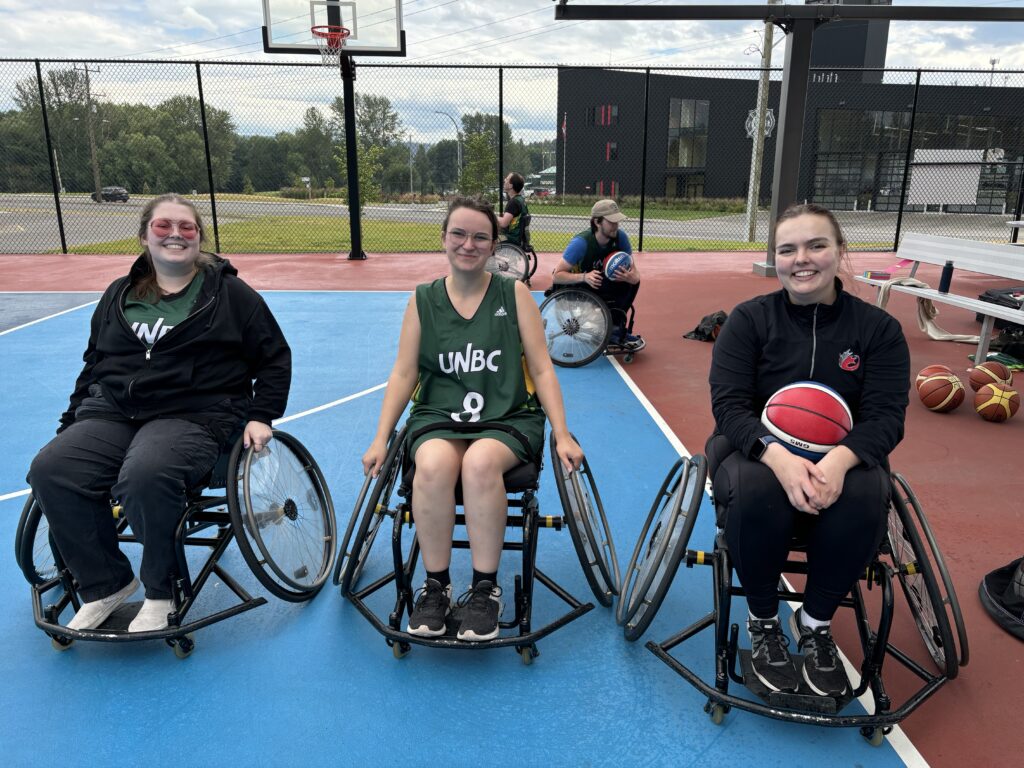
Cohort peers and I post-basketball game – photo posted with permission

What I learned over this term:

  • Peer Collaboration is so SO helpful
  • Networking as a teacher is a MUST – but having a diverse friend group is very beneficial when developing excursions ( they can help with introductions and develop new relationships and volunteer opportunities)
  • You never know if you’re good at a certain skill or activity until you try it
  • Wheelchair basketball is for all people of all abilities
  • It is okay to ask for help

Block 3: Practicum Reflections

As I am writing here today, July 8th, 2024, I reflect on my last practicum in which I was teaching two eighth-grade English courses with a focus on digital literacy. I taught blocks 1 and 4 and was able to witness firsthand how the time of day affects learning abilities and how certain groups of students thrive or fall victim to the influence of their peers.

The classes I taught were the same topics but very, very, different experiences and outcomes. Both experiences were positive, and I am happy with the majority of the student work I received. My morning group of students was taught in a science lab with no windows and I believe that this environment is the reason for some of the work delay and student behavior. It was also the first class of the day for most students, and they were tired first thing in the morning and needed more of a push to start their work and be productive. This class was my most difficult class when it came to attendance, mainly because it was a morning class and we had a bad case of chronic lateness! Not only were latecomers an issue but I also had a student who NEVER came once. I couldn’t even tell you what they looked like, but I can state that one of my peer student teachers taught the student in the second period and they came every single day. Was I the issue? I never found out.

My afternoon block was a complete turnover from my morning class, little to no students missed class without notice and they were constantly excited to learn and participate in lessons. Now I have theories on why they were so excitable, one is that this class was taught in a classroom that had windows! Daylight makes all the difference in encouraging positive perspectives. I was also able to take this class outside more as we were already in a portable class. Having classes outside was quite the adventure, it worked for some topics but was very unhelpful or impossible to complete for others, so to compromise and help relieve their “wiggles” every class we took a 5-minute movement break where the students would lap the school before coming back to class and participating in break out work groups or working on their projects.

I was really pleased to have two relatively easygoing student groups, with little to no tensions between peer groups. My students were willing to try all the ‘fun’ games I came up with for digital media lessons and would help me develop games to be more fun while still being academic.

What did I notice when I compared these two blocks? Well I learned that although I have plans that I made prior to class I need to be adaptive and recognize that one class’s ability to learn something may be faster or slower than the other block and that every day they may not be learning the same exact lesson. Well, to frank, there are no repeating lessons, yes the assignments were the same (for the most part) and the activities were too, but the discussions and outcomes that arose from the lessons differed greatly. Students are unique and diverse individuals so my lessons must be prepared for that.

These are two poems sourced from my morning class (Spring) and my afternoon class (Tanka). They are from the same assignment in which the students were tasked with making original digital poetry books and were given the seasons as a theme in which they could write about, I selected these two to share because they discuss similar natural topics, its the same project but each piece is completely unique- just like the two classes I taught. (Both poems are shared with student permission- no names will be shared to respect their anonymity).

Professional Development: ASD and Sensory Differences

On Monday the 29th of January I attended a workshop hosted by POPARD (Provincial Outreach Program For Autism & Related Disorders) on ASD and Sensory Differences. The main topic covered was that of senses broken down into side topics of The Seven Senses, Regulation and Sensory difficulty.

This workshop was a wonderful source of basic information surrounding ASD and children who live with sensory differences. It was a great introduction to terminology, and recognising student under-stimulation to over-stimulation.

What are senses? Senses allow us to observe and understand the world around us

Something that I found especially interesting was the introduction to the Seven senses which expands on my previous knowledge of the five senses (touch, taste, sight, hearing, smell). The Seven Senses add the vestibular and proprioception to the previous list of five. Vestibular refers to the vestibule that is found within the ear; the vestibule is connected to the sense of movement and balance. Proprioception refers to awareness of the body such as pressure and positions.

Below I have attached a great learning resource depicting the seven senses.

1

Sensory Integration and Regulation

Sensory integration is a skill that all people develop over time and at different rates. My understanding of sensory integration is that it is how we receive information, organise information and then use that information to interact with our environments. Integration is more difficult for some than others, after all, we are all unique individuals, and sometimes we can experience dysregulation or “sensory overload”. Sensory overload can be scary, and triggers are unique to the individual. Some potential triggers may include noise levels, visual stimuli, clutter, transition periods, scents, lighting, personal space boundaries and seating arrangements.

According to Shanker (2013), there are five interrelated domains we can use to better understand self-regulation. Below I have attached the model in which the workshop shared with us.

2

Breaking down the 5 Domain Mode:

  • Biological
    • Four neural mechanisms within the brain deal with stress
      • social engagement
      • fight or flight
      • freeze
      • disassociation
        • there is a hierarchy for responding to stressors that typically follows this listing
    • Through being regulated a child develops the ability to self-regulate.
      • a regulated child/person does not mean a managed child
    • A person becomes chronically hypo-aroused or hyperaroused if/when their central control system has become overwhelmed
  • Emotional
    • many students, especially younger students, find it difficult to “monitor, evaluate and modify” their emotions
    • the more hyper-aroused the student is the less capacity they will have to monitor their emotions
    • Young students experience emotions to an intense extent. Reactions to these emotions may be sudden and can feel ‘catastrophic’
  • Cognitive
    • Refers to any of the mental processes involved in knowledge acquisition
      • includes: attention, memory, problem-solving, perception
    • Sustained concentration is a high-cost demand on the child’s auto-nervous system
    • Many if not most attentional problems appear to be due to sensory processing challenges (auditory, visual, physical sensory etc.) which can appear subtly and can easily be overlooked.
  • Social
    • This domain’s problem lies in the arousal created by social engagement.
  • Pro-Social
    • It is not normal for children to display anti-social behaviour (but what exactly is normal?)
    • There are biological mechanisms that result in anti-social behaviours in the right circumstances
    • Stress overload is a leading cause in non-prosocial behaviour

How to best help our students when they get Over-Stimulated

  • Create a Safe and consistent quiet space
    • Some classes rooms I have observed have reading nooks and quiet carpeted corners
  • Take the class outside for a walk
  • Lead the entire class through meditation/ mindful breathing exercises
  • Allow students access to over-ear headphones to cut out loud surrounding sounds
  • 54321 Method
    • Lead your student through a grounding exercises in which you ask them to name
      • 5 things they see
      • 4 things they touch/feel
      • 3 things they hear
      • 2 things they smell
      • and 1 thing they taste

(I have only ever encountered the 54321 method in very rare/minimal circumstances typically involving extreme anxiety)

  1. CEBM. Theoretical Framework SENSORY AND THE OT PERSPECTIVE ↩︎
  2. Shanker, 2013. as cited POPARD ASD and Sensory Difficulties workshop, 2024 ↩︎

Classroom Hooks: Human Migration

For one of my BEd courses, we were asked to create ‘hooks’ that would hook the interest of our future students on topics we may teach during our practicum or our teaching careers. For this topic, I chose to use a video to play at the beginning of class which depicts global human migration throughout history. I plan to play this video on a loop without context while students arrive to class and once students are settled ask them to inform me what they think they are viewing. Allowing them time to inquire I would then introduce the topic of human migration which would in this context be a unit that would be covered in a Geography 12 course or an upper-level Social Studies (10-12).

Once the video is watched I would start another short inquiry period in which I would ask students reasons for which historic humans migrated and if they think the reasons are similar to modern migration phases. The big ideas I am hoping to hear from their reasoning are as follows:

Why People May Migrate

  • Environmental
    • Climate
    • Natural Disasters
    • Calamities that affect the natural environment
      • nuclear
      • toxic spills
      • etc
  • Economic
    • Career paths
    • To find work
  • Cultural
    • Social causes/safety
      • LGBTQ+
      • Religion
      • Politics
        • War
        • Elections
    • Education
      • better education opportunities allow for better career opportunities

Once a decent-sized list is created we will then flow into the new unit in which will cover the three big ideas.

Beaded Tweets

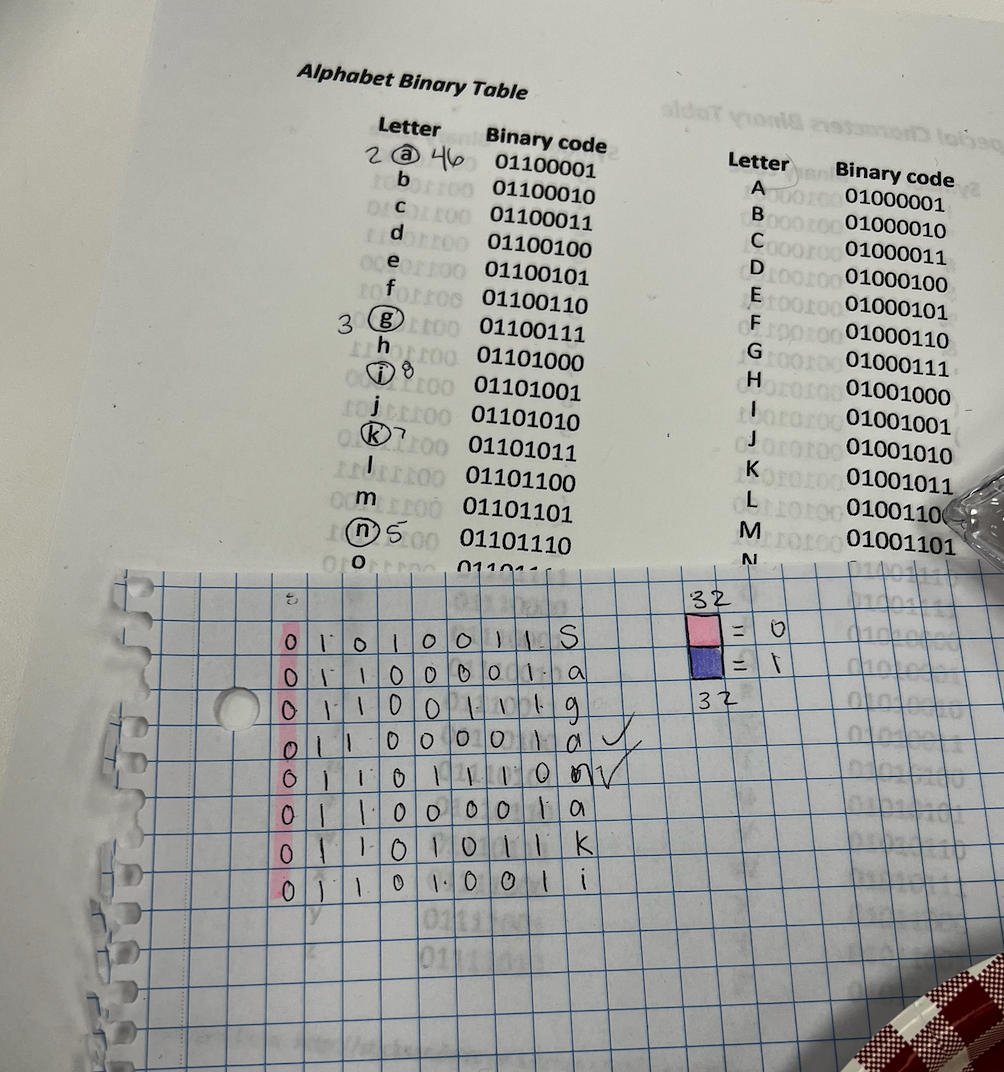
Firstly, I would like to thank Noelle Peppin, @beaded_tweets on ‘X’, for coming to our classroom to teach us how to code via her ‘Beaded Tweets'(1). Unfortunately, I was not on my game that day due to a bad cold, but I did really enjoy learning to code and making secret-coded necklaces! I was able to make two necklaces with Noelle’s codes. The first was made in silver and black beads and spells out the Greek word σαγανάκι (Saganaki), which is a pan-fried sheep’s cheese with lemon. Why did I choose this word? Noelle told us to bead a code that was special to us or something that we love. On that day I was really missing home, and Greek food, specifically Saganaki from Mythos Taverna! My second necklace was made of yellow and black beads, and spells out the word ‘Capilano’. I chose these colours and this word as Capilano is my family’s rugby club and their colours are gold and black.

What’s it all about?

Beaded tweets are all about “how binary coding language and loom beading can be combined to honour both Western and Indigenous traditions”(2). 

The project’s applicability in the classroom will give instructors a tangible opportunity to connect with coding while also focusing on Indigenous themes through beading (3). By practicing a traditional creative practice of many Indigenous communities, beading allows students to learn more about Indigenous cultures and ways of being, while also learning materials and concepts that are required by the curriculum.

Sources:

1)Peppin, Noelle, @beaded_tweets on ‘X’

2)https://www.pgpl.ca/events/master-minds-beaded-tweets

3) Peppin, Noelle. Beaded Tweet. July, 16th 2018. <blockquote class=”twitter-tweet”><p lang=”en” dir=”ltr”>Here’s more detail on my Masters Project. The abstract for Beaded Tweets: Bringing the Digital back to the Physical through Culture (beading) <a href=”https://t.co/QBvcbQJuPn”>pic.twitter.com/QBvcbQJuPn</a></p>&mdash; Noelle Pepin (@Beaded_Tweets) <a href=”https://twitter.com/Beaded_Tweets/status/1019104959004995584?ref_src=twsrc%5Etfw”>July 17, 2018</a></blockquote> <script async src=”https://platform.twitter.com/widgets.js” charset=”utf-8″></script>

Ozobots – Coding

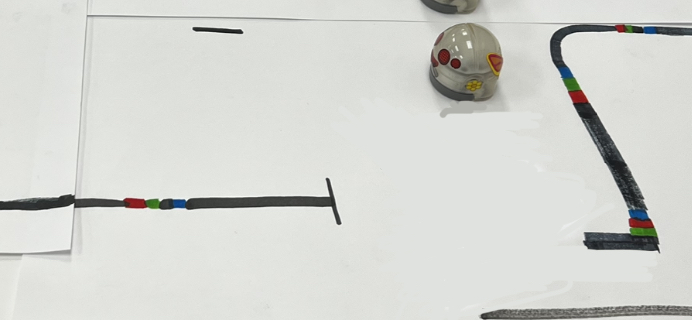
Ozobots are a wonderful way to learn to code, all you need is patience, your bot, 4 coloured markers and paper to create your code map!

As a student in the K-12 system, I cannot recall a time in which my teachers took the time to teach students coding (it probably wasn’t a mandatory curricular task back then)! In the current BC curriculum, coding is something that all students should learn at various times across their academic careers, and what better way to learn than through the creation of circuits for adorable little mobile robots? It may be that students have done some prior unplugged algorithms (simply following and providing instructions), but with the use of Ozobots, this experience becomes more interesting as this fun tool will create lasting coding memories for students of all ages(1).

How to Code?

Prior to obtaining their robots, students will be introduced to the code charts and instructed on how drawing lines and colour codes will allow them to experiment and create unique algorithms for their Ozobots to follow.

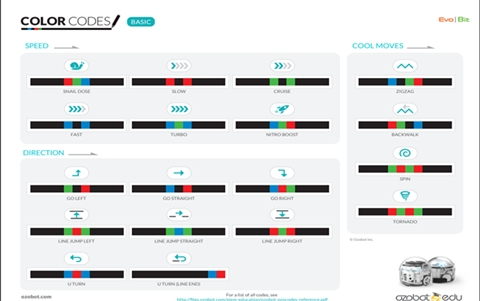
Ozobots use sensors to determine what codes you or your students have created in their circuit sequences. Posted below is a chart of codes which the Ozobots are programmed to identify, such as a tornado, nitro boost and snail dose(2)!

https://www.digitaltechnologieshub.edu.au/teach-and-assess/classroom-resources/lesson-ideas/introduction-to-ozobot-and-colour-codes/

Once they are introduced and made somewhat familiar with the codes, they will be tasked to create a circuit/map for the Ozobots to maneuver. Maps and circuits can look complex or simple, what’s important is that a variety of codes are utilised.

What if it doesn’t work?

There were some complications in my experience with the Ozobots, our bot appeared to have tantrums! Multiple factors may result in the disruption of your circuit route. Robots may not be able to read your code due to drawings being too skinny or too wide, or the colours not being distinct enough to read. Other variables include the battery power of your bot. It is my belief that our initial bot was either a low battery or had a loose wire somewhere (perhaps a loose screw?), as it began to ignore all codes and just spin in circles.

The Importance of Coding:

It is important to teach coding as it “enables children to use digital technology to develop their creativity”(3). In our technology-based society, coding teaches our students to move from the ‘consumer’ role to the ‘creator rule (ibid). In conclusion, learning to code helps students to develop an understanding of one aspect of the technological world and helps them to be better prepared for when they enter it as young adults.

Sources:

  1. Ozobot. “Ozobot | Robots to Code and Create With,” November 15, 2023. https://ozobot.com.
  2. Hub, Digital Technologies. “Introduction to Ozobot and Colour Codes.” Digital Technologies Hub, n.d. https://www.digitaltechnologieshub.edu.au/teach-and-assess/classroom-resources/lesson-ideas/introduction-to-ozobot-and-colour-codes/.
  3. https://www.desjardins.com/ressources/pdf/d25-12-reasons-learn-coding-school-e.pdf?resVer=1568637206000

Reflection: Two Rivers Gallery.

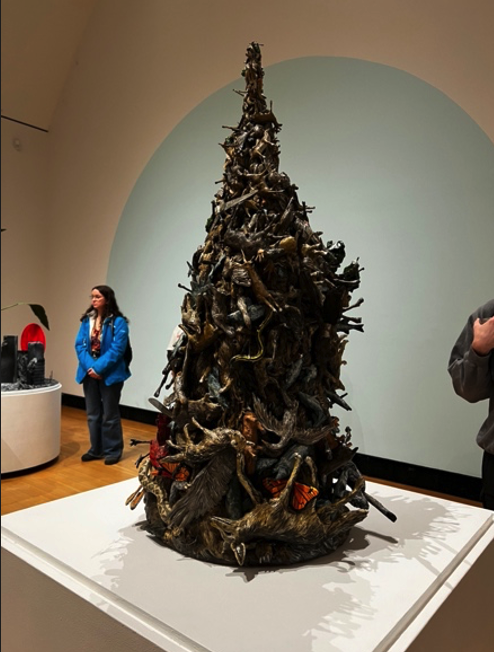
November 6th saw our cohort touring the Two Rivers Gallery in downtown Prince George. It was such an interesting and emotional visit, as the two current installations are very striking statements on climate change and threats to our local environments. The lovely Sophia was kind enough to give us a tour (highly recommend her for future visits) of the exhibits and lead us through a unique and creative art project of our own after the tour.

Exhibit 1: Nonreturnables

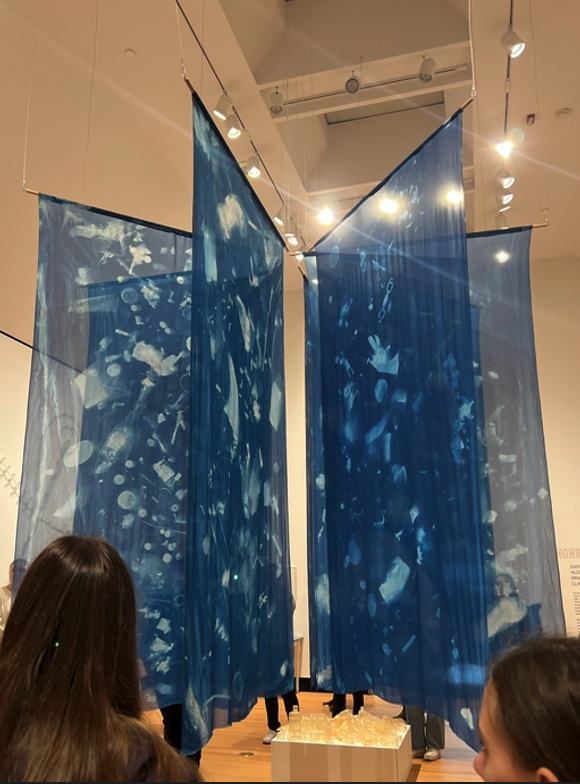
 Nonreturnables is a collection of artwork made by artists from across British Columbia and the relationships we share with plastic in the biological world. This exhibit was the definition of “REUSE” in the Reduce, Reuse, Recycle slogan! The centrepiece of this exhibit was a large flowing cyanotype hanging instalment with cushions for viewers to lie on underneath; It is titled ‘Plasticosis’ by Desirée Patterson. 

I was really drawn to this piece, as I am from the coast (Vancouver area) and am very well-versed with shoreline garbage abundance. It was also very impactful to me as the plastics with which this piece was created are those that were collected from the beaches around Vancouver. I found that the interactive component of this art piece was effective and educational but also very soothing as the cloth would sway gently like the ocean from the perspective of ocean creatures. The use of the cyanotype process really allowed for the fabric to emulate the ocean as some of the fabric developed more than others allowing for a variation of blues to be present in this natural photography process.

How could I use this exhibit in my teaching? 

Easy! By introducing this exhibit, and other art that is similar in creation (using recycled materials, I could integrate this idea in multiple contexts: a science program, geography program and art program, for this art process involves learning about the health of our environment, the cleaning of our landscapes and the creation of art from the garbage in which we would collect during the process. By using garbage in which the students themselves have collected and a brief write-up of where they collected said garbage, I believe this exhibit could easily flow into a variety of courses and be a very fun, yet educational process.

Exhibit 2: Dismantled Worlds

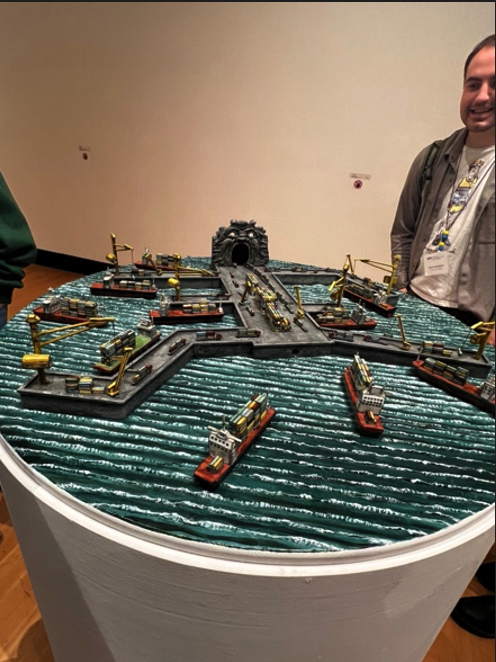
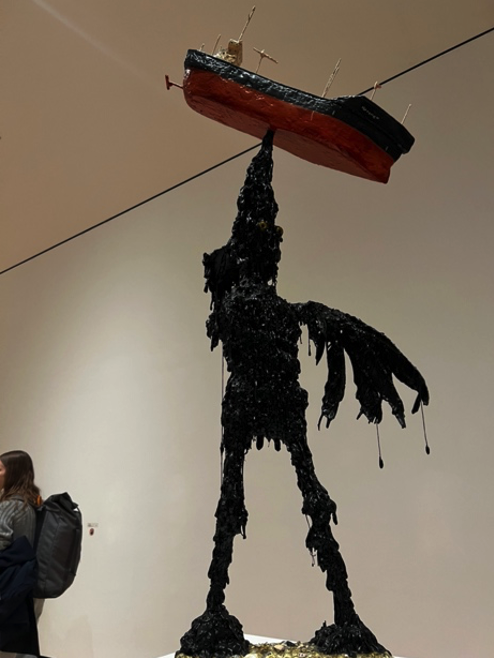
Dismantled World by Jude Griebel is a humorous yet nightmarish collection of works representing the “toxic relationship between natural life and human industry”(1). The collection was seven distinct humanoid sculptures made of mixed media depicting monster-like creatures made of natural occurrence, natural disasters and human industry as well as two piles depicting types of food pyramids. As the gallery’s website states, “This surreal sculptural interpretation of capitalism and resource extraction blends anatomy with landscape and satirizes the effects of industry-caused climate change”.

            This was a very disturbing collection, as you feel very connected to these disastrous event creations, especially since multiple of the beings represent dismantled and disastrous coastal monsters made of cement ports, oil spills, displaced molluscs and weeping icebergs.

            Sophia, our host, led us through an exercise to better connect with the pieces which included deep breathing, focusing on multiple aspects of the piece and deep thinking. It was a very centring exercise that really allowed us to create relationships with the pieces. As wonderful as the exhibit and the exercise were, this collection really disturbed me, meaning that it was extremely effective!

Final activity:

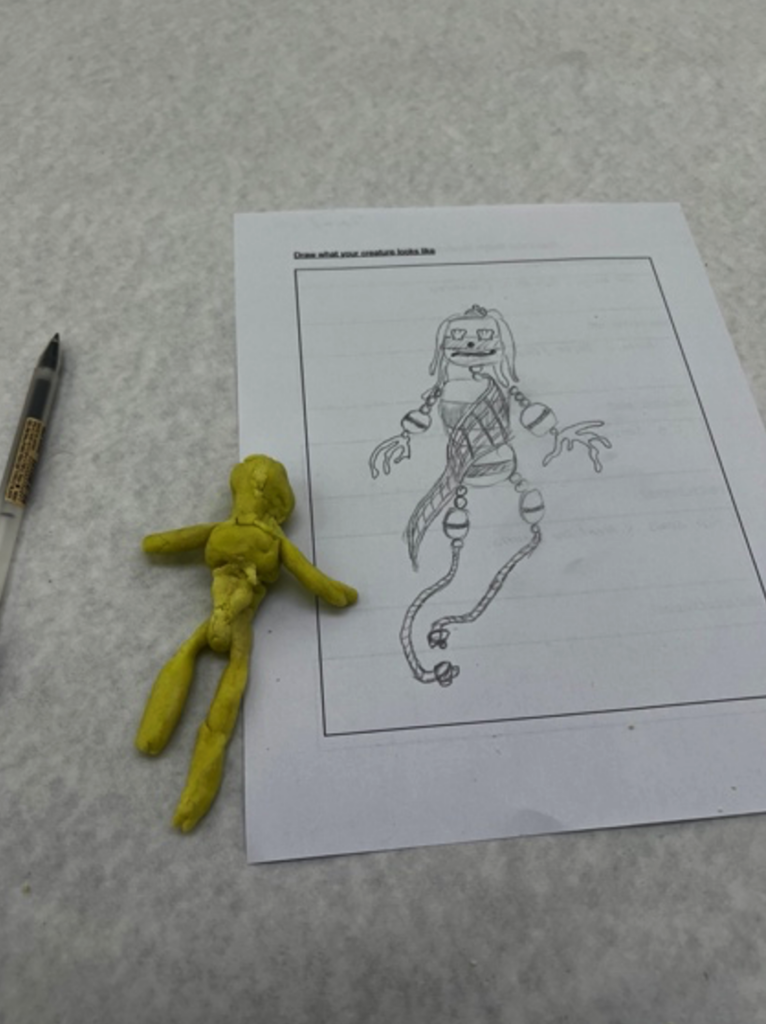
Our Final activity at the gallery was the creation of our own monstrous recycled creations first drawn by hand and then attempted with playdough. There were multiple questions for us to fill in in the creation of our creatures such as: What is it made up of? Where does it live? And so on. My creation is a coastal creature who lives within the Indian Arm and Burrard Inlet. Their name is S.S Ingsdon and they are made up of old buoys, fishing lines, old fish nets, seaweed and shells. My creation’s purpose is to haunt those who litter in the ocean in the areas in which it abides. 

This activity was a lot of fun and is something that I could see easily applied to the education of students of all ages. It allowed for so much creativity and was such a fun bonding experience between our cohort.

References:

  1. Two Rivers Gallery. “Current Exhibitions – Two Rivers Gallery – Prince George BC,” February 8, 2023. https://www.tworiversgallery.ca/exhibitions/current-exhibitions/.

Library Time!

How we can best utilize our Public Libraries in our academic and personal learning!

Did you know that…

  • All B.C children have a RIGHT to a library card
  • If you already have a library card from another location within BC you can apply for a BC One Card Library Card!
    • One Card users are able to take out books from all participating libraries across BC without having to be local!
  • Library cards are free to all people who live or own property in the City of Prince George! (at least the first card you get is)
  • The Prince George Public Library (PGPL) is a fine free library!
    • that’s right! The PGPL wants to encourage readers and their reading, so as long as you don’t wreck a book, lose a book OR print more than 30 pages a day at the library!
  • It’s not just books you can borrow from the library!
    • Teenagers under 19 are able to borrow remotes to video game consoles that are open to public use at the downtown PGPL location
    • You can borrow KITS: a selection of learning tools and media stored inside tubs that can be borrowed from the library! There are multiple types of KITS ie) Snap Circuits, HAM Radios, Robotic Kits and Story Kits (based on themes), Sewing Kits, Bike Repair kits etc.
  • The PGPL has a free Tutoring Program!
    • The homework help program is a free tutoring program of all k-12 subjects free for all students and youth
    • if you plan to apply for homework help as a student do so EARLY as they do fill up quickly!
  • The PGPL offers Sensory Kits for internal Library Use
    • these kits include sound limiting headphones, weighted blankets, fidget toys and more!

The Right to Read!

Library Cards of the Prince George Public Library (https://www.pgpl.ca/cards)

Library Cards are free to all those who apply at the Prince George Public Library locations. All you need to apply is proof of identification such as a driver’s license, student identification card, personal health card or proof of residency. All citizens have the right to read, and Libraries will help all youth to obtain a library card with or without available IDs as it is their belief that all citizens have the right to read!

VOX, Audiobooks and Ebooks!

The Prince George Public Library is very inclusive and accessible to readers of all types and has VOX (talking books that have mp3s in them to read aloud to you), physical audio-books available in the library and virtual audiobooks and ebooks available through the library online database! If you are searching for books in braille, the library online database also has books through NNELS that can be transferred onto your plug-in braille devices! If you are interested in discovering the online ebooks/audiobooks and more you can find more information on the PGPL website under ‘Online Resources- Books and More’.

follow this link for more: https://www.pgpl.ca/online-resources

Films, Television and Video Games!

The PGPL has a large selection of films, television series and video games for a variety of consoles available for the public to borrow. The video games are only able to be sourced for borrowing from the physical libraries. However, if you’re unable to physically visit the library, don’t worry, The PGPL has multiple online databases in which you are able to watch film and television! Through the ‘Books and More’ section of the Online Resources on the PGPL website, these visual media can be found under the application titled “HOOPLA”

How PGPL (and other Libraries) can be useful to Educators:

The PGPL is a great resource for teachers and students alike, as it’s a wonderful place to source books, films and education KITS great for lesson plans and projects! As we noted above, KITS, films and books are easily accessible within the library and are not just limited to teachers. However, there is something unique to teachers alone that is accessible through the PGPL, and that is the ability to order a selection of books and media through the library on specific themes in which the librarians will source books for you to choose from! This takes the pressure off of you as a teacher to spend your own personal time looking for texts which you need for class.

The PGPL also has multiple private study rooms in which you can book for two-hour increments, which could be super useful for lesson planning, marking and more! I already utilise these rooms and find them super beneficial to my production levels.

Finally, something that isn’t technically targeted at teachers is the selection/collection of book club books that the library has, as these could be super useful to us teachers when doing novel studies. These texts, however, may be limited, so this may be something to look into further.

Sources:

(1)“Prince George Public Library,” n.d. https://www.pgpl.ca.

*All graphics made by me with the use of Canva.com

Page 2 of 3

Powered by WordPress & Theme by Anders Norén